How to Stay Consistent on YouTube When Motivation Runs Out
Two in the afternoon. Thirty-two degrees Celsius, which is around ninety in Fahrenheit. The sensible move was a nap. I got on a bike and rode twenty kilometres instead.
The road threw the heat back up at me. Headwind on the long stretches. Legs heavy. And somewhere around kilometre twelve, the thought arrived that I have had a hundred times sitting in front of an unfinished script: nobody would know if I stopped here.
That thought is the entire problem. Not the heat. Not the wind. Not the algorithm, the niche, the camera, or the year you happened to start. Just that quiet, reasonable voice offering you an exit that nobody else will ever audit.
Nine years into building YouTube channels for English-speaking audiences — mostly faceless, mostly slow at the start — the thing I would go back and tell myself is not a tactic. It is this: the creators still standing after three years are almost never the most talented ones. They are the ones who built a floor low enough that a bad week still cleared it.
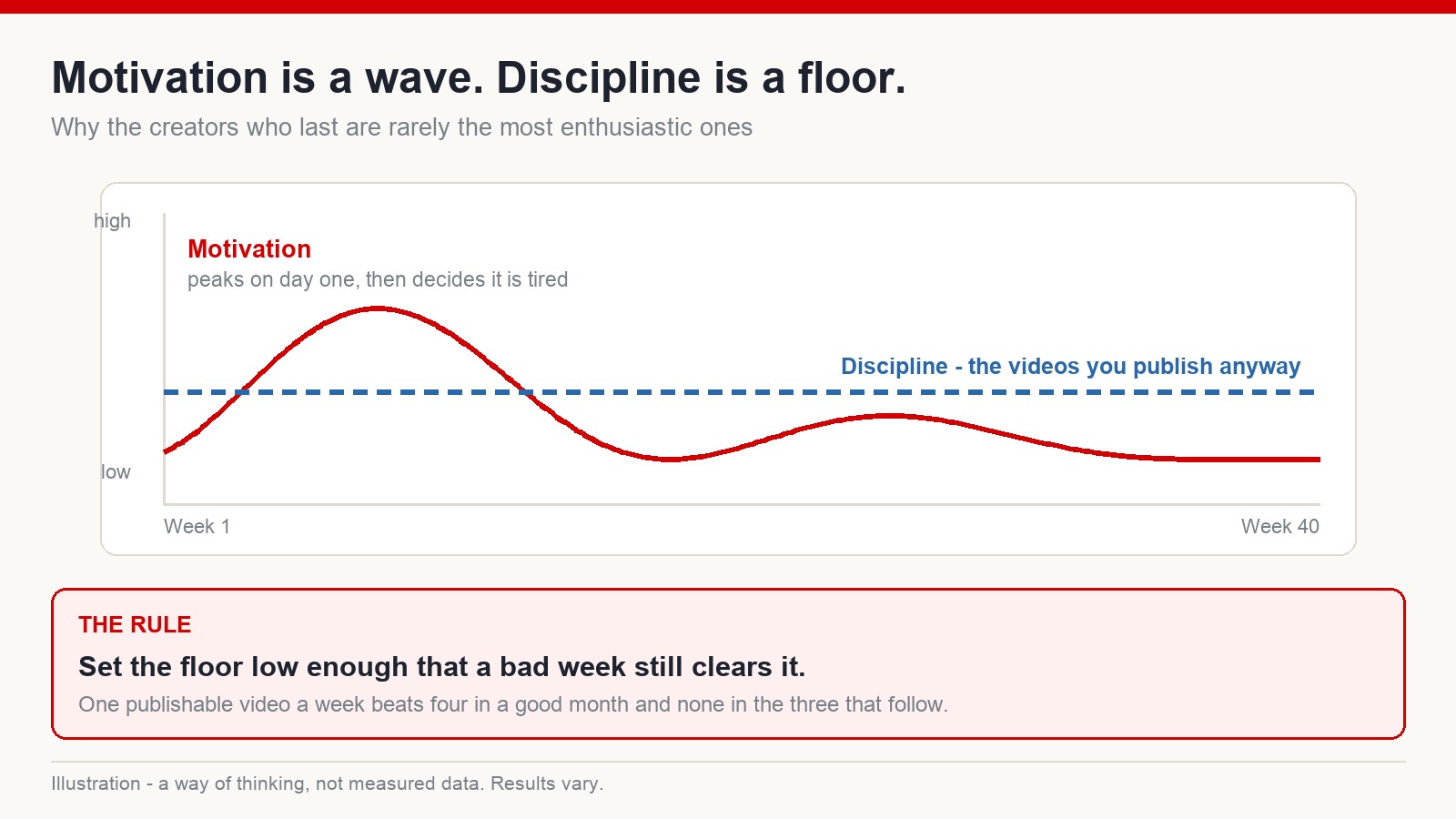
Motivation is a wave. Discipline is a floor.
Motivation is real. It is just not a supply you control. It spikes when you watch a good video about someone who made it, and it evaporates when you open your analytics on a Tuesday and the last upload did nothing.
Ask anyone who quit YouTube why they stopped, and they will not tell you they ran out of ideas. They will tell you they stopped feeling like it. Then two weeks passed, then a month, and coming back started to feel like an apology they owed to themselves.
Discipline asks a different question. Not do I want to do this today? but what did I say I would do? It is not grim, and it is not about becoming a machine. It is about deciding once, in a calm moment, so you are not renegotiating with yourself at 11pm when you are tired and your last video underperformed.
Here is the practical version. Set your publishing floor at the level you can hit in your worst week of the quarter, not your best. One decent video a week that survives a hard month beats four in a burst and then three months of silence. The burst feels productive. The floor is what actually compounds.
Big sessions start with embarrassingly small objects
Before that ride I ate a banana and filled a water bottle. That is it. That is the whole heroic beginning.
I have paid attention to this for years now, and it holds up almost every time: I never decide to do the hard thing. I decide to pick up the first object. Fill the bottle. Put the shoes by the door. Open the script file and write one line I already know is bad.
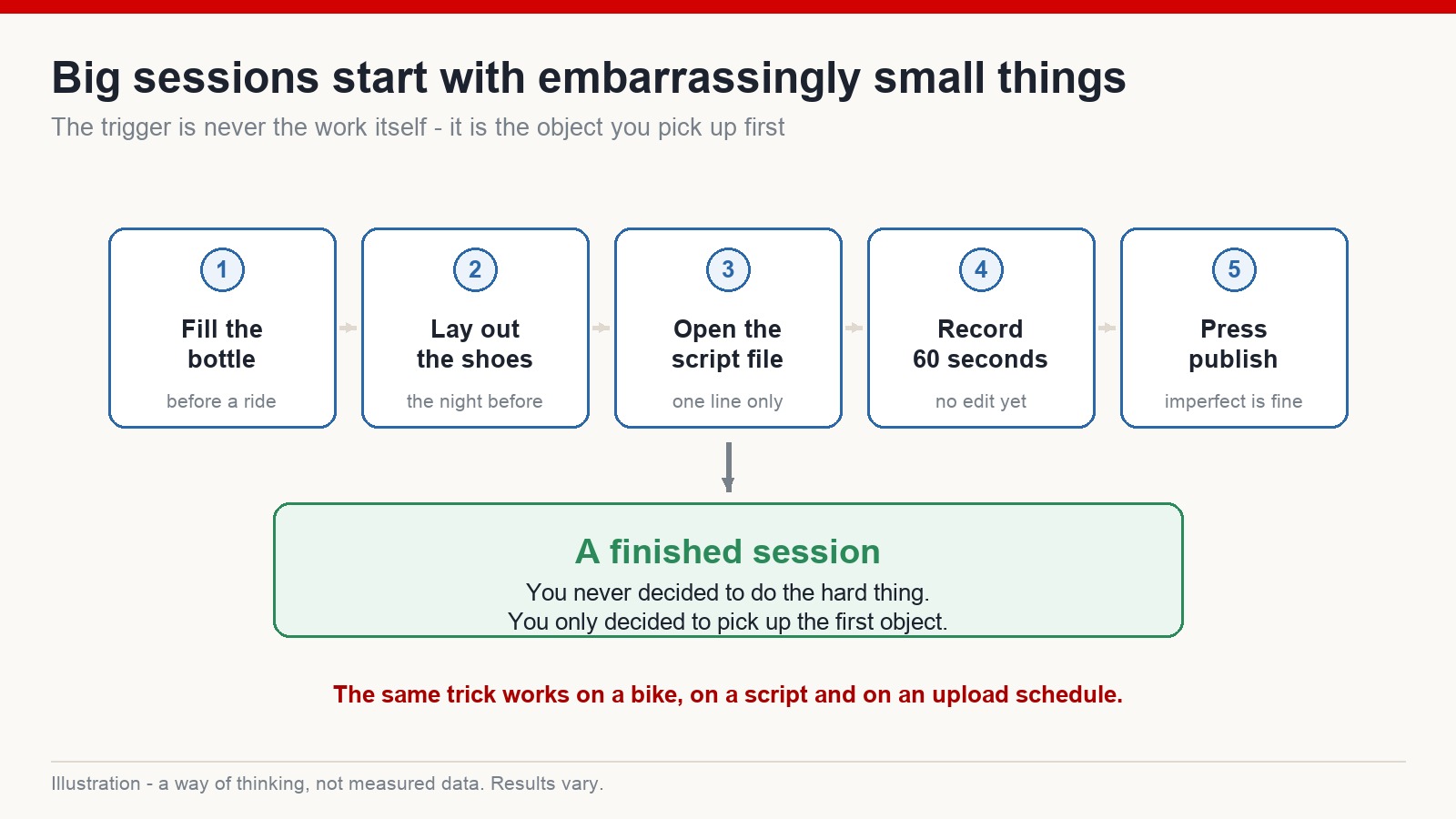
The resistance you feel is almost never attached to the work. It is attached to the size of the work as you are currently imagining it. “Make a video” is a boulder. “Open the doc and write the first line of the hook” is a pebble, and once you are holding a pebble you are already in the room.
So make the entry point stupidly small and completely specific:
- Not “research the niche” — open one competitor channel and read the titles of their last ten uploads.
- Not “write the script” — write the first sentence, badly, with the intention of replacing it.
- Not “record” — hit record and talk for sixty seconds with no plan to keep it.
- Not “learn editing” — cut one thirty-second clip end to end.
Nine times out of ten the session runs long past the pebble. The tenth time it does not, and you still did something, which beats the version of the day where you thought about it for two hours and produced nothing.
There are two kinds of not working, and only one of them helps
After the twenty kilometres I swam a kilometre. Cold water on an overheated body is a strange, excellent feeling — less like cooling down and more like a nervous system rebooting. That is rest, and rest is not the enemy of consistency. It is part of it.
But there is a second kind of not-working that dresses up in the same clothes, and it is corrosive.
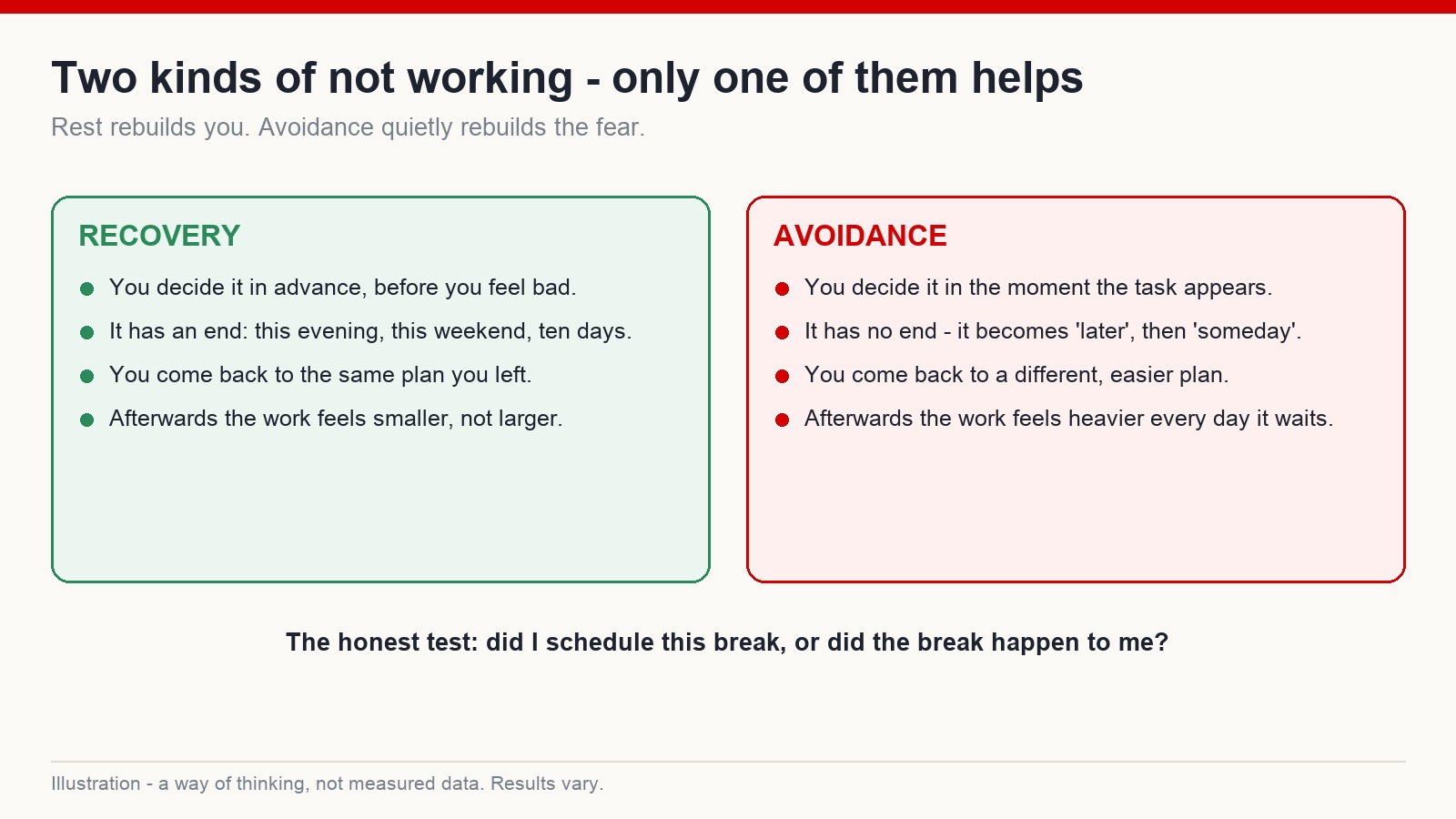
The test I use is simple and slightly uncomfortable: did I schedule this break, or did this break happen to me?
Recovery is decided in advance, before you feel bad. It has an end — this evening, this weekend, ten days off after a launch. You come back to the same plan you left. And afterwards, the work looks smaller.
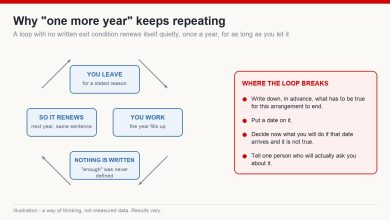
Avoidance is decided in the exact moment the task appears. It has no end; “later” becomes “when things calm down” becomes nothing. You come back to a different, easier plan — a new niche, a new format, a fresh start that conveniently requires no evidence of the last one. And afterwards the work looks heavier, because it has been sitting there gathering dread.
Take the rest. Genuinely. Just book it, and know which one you are taking.
The excuse is never the real thing
Thirty-two degrees was a perfectly good reason to stay in. And that is what worried me about it.
If I let the heat be the reason today, tomorrow the reason will be that I am busy. Then that I am flat. Then that nobody watched the last one. Then that the market is saturated, the algorithm changed, the niche is dead, my English is not good enough, the equipment is not good enough, this year is not the year.
Every one of those sentences is defensible. That is what makes them dangerous. Reasons are infinite and free; results only ever show up for the person who worked while holding a reason not to.
This is also why “I lost motivation” is such a poor diagnosis for a stalled channel. It describes a feeling, not a cause. Underneath it there is usually something specific and fixable — the format takes eleven hours to produce, so of course you dread it; you never defined what a finished video looks like, so nothing is ever finished; you set a schedule for a version of your life that has a spare evening it does not actually have.
A channel needs reps the way a body does
You cannot read your way to endurance. You can understand the physiology perfectly and still fall apart at kilometre fifteen, because the adaptation only comes from the reps.
YouTube is the same, and this is the part beginners resist hardest. People quit at five uploads because nothing moved. At ten because they doubt themselves. At thirty because they have decided they are not built for this. But five videos is not a verdict on your ability — it is barely a first draft of your understanding.
Every upload teaches you something the theory cannot:
- Which packaging earns a click from a stranger who owes you nothing.
- Where in your script attention actually leaks — a real timestamp, not a guess.
- Which of your ideas people bother to comment on, and which land in polite silence.
- How long the work genuinely takes you, once the enthusiasm has worn off.
None of that is available from the sidelines. And the reps compound in an unusual way: the tenth video is easier than the first not because you got braver, but because ten videos’ worth of decisions have quietly turned into defaults.
Judge your channel against your own back catalogue
One more thing worth saying plainly, because it wrecks more consistency than laziness does: most creators measure themselves against numbers that were never about them.
You read that a “good” click-through rate is some figure, that a “healthy” retention curve looks a certain way, that a channel your size should be earning a certain amount. Those numbers come from other niches, other countries, other audiences and other years. Held up against them, a perfectly healthy channel looks like a failure, and people quit over an illusion.
The only fair control group you have is your own last ten videos. Is this thumbnail beating your median? Did this hook hold longer than your usual? Did this topic bring in more new viewers than your average? That comparison is honest, it is available to you today, and — this is the part that matters here — it gives you something to improve that does not depend on how you feel.
Results vary enormously between creators, niches and markets, and platform rules change without warning. Consistency does not entitle you to an outcome. It just makes you the kind of creator an outcome can happen to.
What the discipline is actually for
After the ride and the swim I went to work, then picked up my kid. That is the honest reason for all of it. Not the training, not the numbers, not proving anything to a feed.
Freedom is not a personality trait you either have or lack. It is a slow accumulation of small kept promises — the sessions nobody saw, the videos published in weeks when they were not fun to make, the choices that looked unimportant from the outside. The bill for it gets paid in ordinary days, well before the freedom shows up.
So if you are somewhere hard right now, I would not aim for strong. Aim for not hiding today. One video published while it still feels invisible. One script finished when nobody is waiting for it. One rep that nobody claps for.
Three years from now, the thing you will be grateful for is not the easy day. It is the one where you went out into the heat anyway.
Frequently asked questions
Why does discipline beat motivation for creators?
Motivation tracks your mood, which is largely outside your control and reliably lowest right after a video underperforms. Discipline is a decision you made earlier, in a calm moment, about what gets done regardless. It is not about willpower — it is about not renegotiating with yourself every single day.
How often should I publish on YouTube?
Whatever cadence you can sustain in a bad week, not a good one. For most people starting out that is one video a week, sometimes one every two weeks for research-heavy formats. A pace you can hold for a year beats an ambitious schedule you abandon in six weeks, because the platform and your own learning both need a steady supply of data.
How do I know if I need a break or if I am avoiding the work?
Ask whether you scheduled it. Recovery is planned in advance, has an end date, and you return to the same plan. Avoidance is decided in the moment the task appears, has no end, and you return to a different, easier plan. Take real breaks; just book them.
I have published thirty videos with very few views. Should I quit?
Not on the view count alone — that number tells you almost nothing about what to change. Read your own analytics in order instead: click-through rate first (is the packaging earning the click), then the retention curve (where exactly do people leave), then traffic sources, then whether the topic still matches the audience you attracted. Change one thing, publish, and read it again.
Does physical training actually help with creative work?
For me, clearly yes — mostly as energy and tolerance for discomfort rather than anything mystical. The more useful transfer is the mental habit: showing up on a day you do not feel like it is the same skill in both places, and it gets easier with practice in either one.
If you want a structured way to build that consistency into an English-language channel, that is what I teach at mmoyoutube.com.